
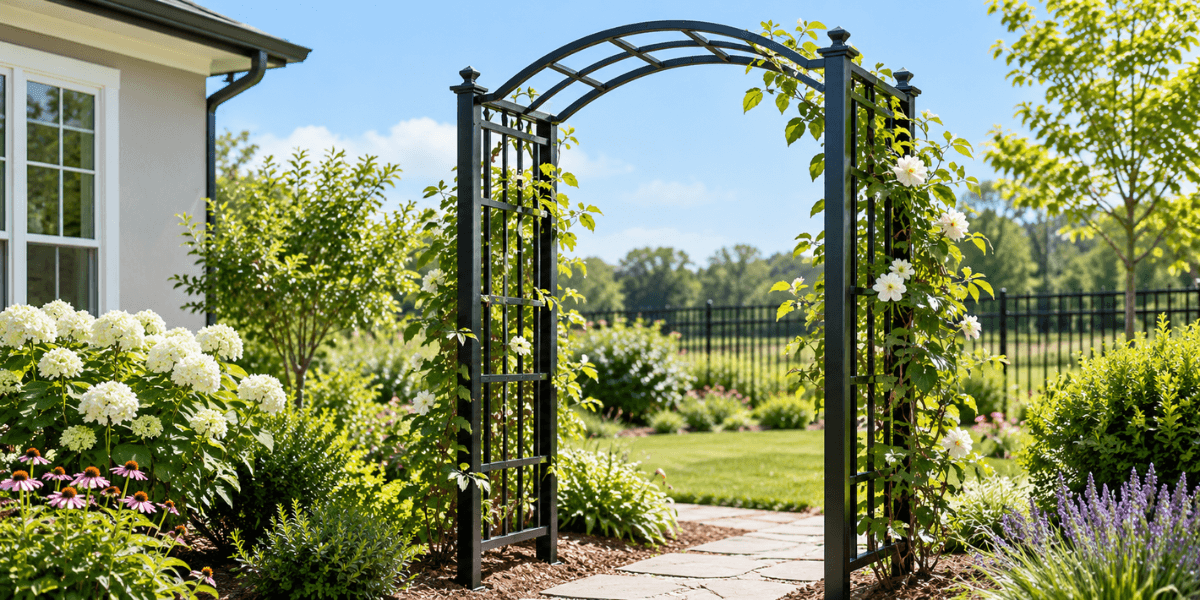
Have you ever walked up to a garden entrance and felt that something was slightly wrong, without knowing why? Usually the cause is proportion. An arbor can be beautifully made and still look awkward when it was chosen before anyone asked how the space actually gets used. A structure that impresses in a showroom may feel cramped above a busy path or get overlooked beside a large house.
The good news is that a handful of thoughtful decisions about width, height, and shape will prevent that disappointment. Iron gives you generous freedom to get each of those choices right, and this guide shows you how to make them with confidence.
How Big Should an Arbor Be for Your Yard
Before you pick up a tape measure, answer three simple questions about the space. Who will walk through the arbor, where will it stand, and what surrounds it? A front entrance used by guests and delivery drivers needs more room than a side path you use alone. If you often carry tools or planters along the way, choose the wider end of any range you see, because a structure that feels tight on day one will feel even tighter once plants fill it in.
Garden Arbor Dimensions That Match Your Space
These measurements are useful starting points, not universal standards. The right dimensions depend on the arbor’s purpose, surrounding space, and the plants it will support.
| Location or type | Suggested height | Suggested width |
| Patio use | At least 7 feet | Varies with the space |
| Grape arbor | 8 feet | Fits an 8-by-8-foot area |
| Walkway arbor | 7 to 8 feet under the beam | 4 to 6 feet |
| General retail range | 8 to 10 feet | 42 to 122 inches |
Arbor Size for Garden Paths and Gates
The table shows how much the numbers shift with placement. The Build Construct guide adds that a walkway arbor should be wider when it frames a gate. It also says a freestanding arch typically needs a depth of 2 to 4 feet, and that designs with a bench need more. Depth is easy to forget, so decide early if you want a light frame or a true passageway.
Choosing a Shape That Fits Your Property
Size gets the arbor through the gate, but shape sets the entrance’s mood. Iron handles a wide range of styles because you can bend it into gentle curves or finish it with decorative scrollwork. These are the main choices to weigh:
- An arched top gives the entrance a traditional, welcoming look that pairs nicely with classic homes and cottage-style planting.
- A flat top has straight lines that feel contemporary and suit modern architecture.
- Scrollwork and curves add decorative details that can echo your fence, gate, or porch.
- A plain, minimal frame keeps the look quiet and lets climbing plants take center stage.
Try repeating one detail from your home in the arbor, such as a curve, a pattern, or a finish. That small link makes the entrance feel planned, not added later. Placement matters too, because an arbor at the end of a path draws the eye toward whatever sits beyond it. Think about what you want people to notice first.
Ready to turn your measurements into something built to last? Ensley Iron crafts custom ornamental ironwork in Birmingham, AL, including iron garden arbors, so reach out for an estimate.
How to Choose an Arbor Size With Plants and Clearance in Mind
Once you have a rough width and height, test them against daily life. Fine Gardening advises paying attention to the size, durability, and strength of the plant you plan to grow, and notes that a long-lived climbing rose needs sturdy, long-lasting support. A walk-through arbor should also handle wheelbarrows and garden carts, and one guide recommends an interior width of at least four feet and a height of at least seven feet so heavy vegetation can drape without blocking the way.
Material plays a part as well. Family Handyman says an iron arbor set deep in the ground can withstand high winds. It also warns that iron can rust, so a treated and painted finish gives it the longest life.
Test the Proportions First
Do you know the height but not the width? One designer points out that no official standards exist, but suggests a width of about two-thirds of the height. Following that idea, an arch with 8 feet of clearance suits a width of about 5 feet. Mark the footprint on the ground with tape or stakes to see how the structure will feel before you commit.
Leave Space for Gates and Walkways
Clearance around the arbor is easy to overlook. The Build Construct guide recommends setting posts at least six inches clear of the walkway edge so the structure does not scrape shoulders. It also suggests adding six inches on both sides when the arbor spans a gate so the gate can swing freely. The same guide says a single-story home suits an arbor no taller than the eaves line, while a two-story home can carry a taller arch.
Frequently Asked Questions
1. Can an arbor be too large for a narrow path?
Yes, an arbor that is too wide overwhelms a narrow walkway, while one that is too small looks out of place. Mark the planned footprint on the ground with tape or stakes to check proportions before you commit.
2. Does an arbor need extra room for climbing plants?
Climbing plants add weight and bulk as they grow, so extra width and height keep the passage clear. A sturdy frame also matters, especially for vigorous vines that become heavy over time.
3. How deep should an arbor be?
Depth depends on how you plan to use the structure. A shallow frame keeps the look light, while a deeper one suits a bench or a true passageway. Choose a depth that fits the surrounding space.
4. Can an iron arbor handle strong wind?
Yes, when it is installed properly. Iron is heavy, and setting the legs deep in the ground adds stability in windy conditions. A treated and painted finish protects the metal from rust and helps it last longer.
5. Should the arbor match the height of my house?
It should suit your home’s scale. A single-story house usually looks best with an arbor that stays below the eaves line, while a two-story house can carry a taller arch. Matching the scale keeps the entrance balanced.
A Final Word Before You Measure
A well-sized arbor comes down to honest answers about how you will use it. Think about the people, the plants, and the style of your home, then let those answers guide the width, height, and shape. Leave generous room for growth and movement, and choose finishes that will stand up to the weather. If you do, your arbor will feel like it has always belonged there.
Want your new entrance to match the rest of your property? Ensley Iron also builds exterior iron railing for decks and porches in Birmingham, AL, and you can request a free quote today.